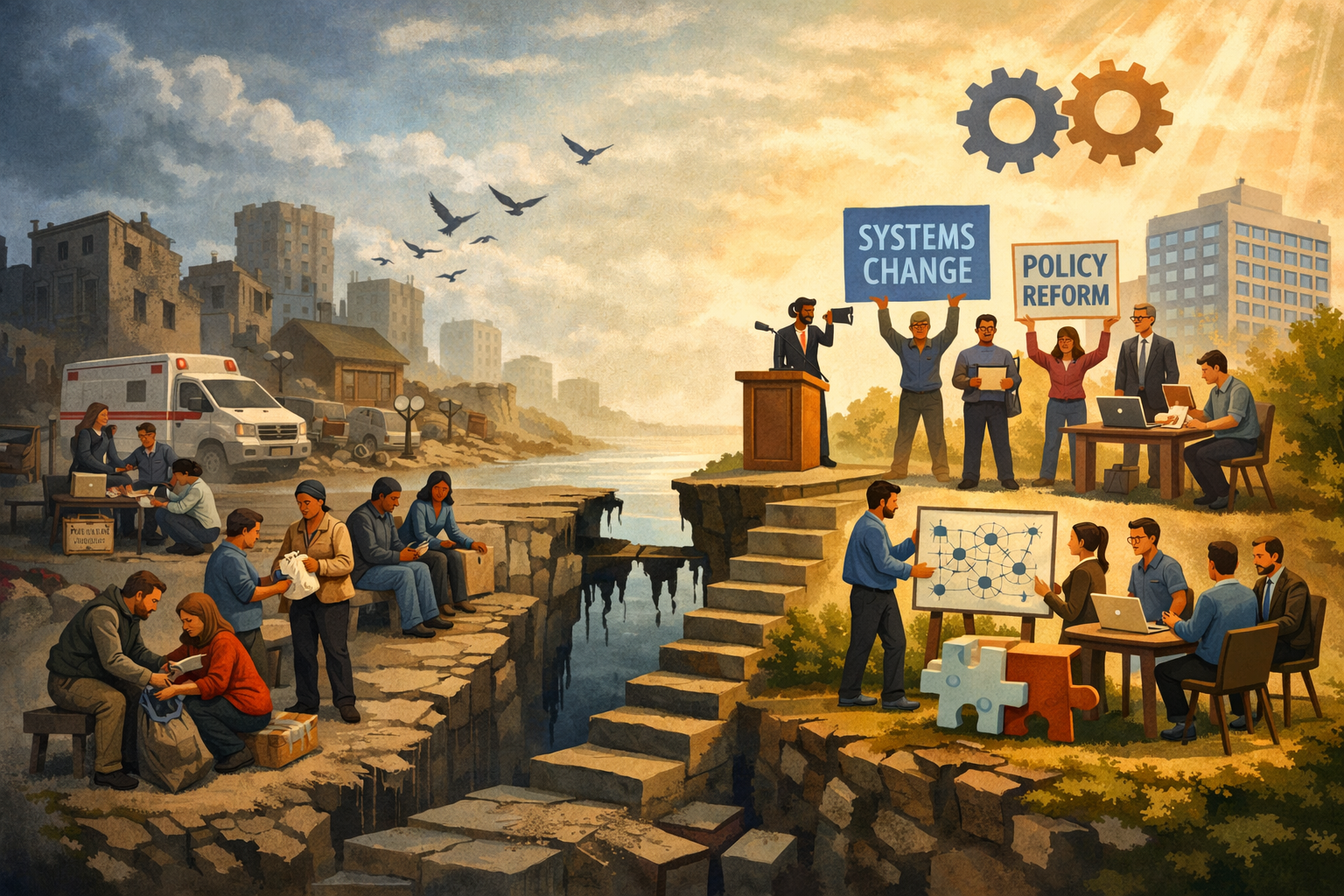
Something has been bubbling up in the sector lately, and it’s becoming hard to ignore. More and more charities that once defined themselves by what they delivered are now stepping back from delivery altogether. Not reducing it. Not balancing it. Stopping it.
Instead, they’re pivoting toward influencing, campaigning and shaping the systems that produce the very problems they used to respond to.
This isn’t a small tweak in strategy. It’s a fundamental change in identity.
Why this shift is happening now
Most charities were built on a simple premise: see a need, meet that need. Run the service. Deliver the support. Be there when things go wrong.
But the combination of rising demand, shrinking resources and deepening structural inequality has made that model feel increasingly unsustainable. Many organisations I work with say the same thing in different ways:
“We’re spending so much time dealing with the fallout that we can’t touch the cause.”
When you’re permanently firefighting, you eventually look up and ask whether you’re helping people or just helping the system stay the same.
That’s the moment organisations start to rethink their purpose.
The rise of “strategic exit” from direct delivery
In the past, a charity stepping away from delivery was framed as a failure, a funding cliff or a loss of capacity. Now, it’s starting to look more like a deliberate strategic move.
The logic goes like this:
- Delivery is increasingly expensive Staff shortages, compliance requirements and cost inflation mean every unit of support is harder to deliver.
- Demand keeps rising faster than capacity Even excellent services feel like they’re swimming against the tide.
- The same structural barriers keep showing up in reports, case notes and dashboards
- Influencing these barriers feels like the only way to create anything resembling long-term change.
So organisations are choosing to stop being part of the management of the problem, and instead work on the architecture of the problem.
From service provider to system shaper
This shift isn’t about charities abandoning people. It’s about redefining where they sit in the ecosystem. I’m seeing charities move from being providers to:
- Conveners
- Advocates
- Storytellers
- Data holders
- Policy influencers
Their frontline experience becomes their evidence base. Their relationships become their leverage. Their community voice becomes their mandate.
Instead of delivering ten thousand interventions a year, they’re focusing on changing the conditions that make those interventions necessary.
What’s driving this change?
A few forces are pushing this trend:
- Exhaustion at scale Many organisations have realised they simply cannot deliver their way out of the problems they exist to solve. When burnout becomes a structural outcome rather than an individual one, something has to give.
- More sophisticated data Once you have live, real-world data showing that the same structural barriers are producing the same outcomes across place after place, it’s almost impossible to keep pretending that more service hours will fix it.
- Funders shifting expectations Some major funders now explicitly encourage influencing, systems thinking and root-cause work. In a tight funding climate, charities follow the incentives.
- Community demand for longer-term change People don’t want the system to manage their hardship more efficiently. They want the hardship to stop. Charities are listening.
What this means for the sector
If this trend continues, we'll see a sectir where some organisations no longer run services at all, instead chosing to specialise in convening communities with decision makers, making use of data insight and storytelling as their core tools. Crucially this will see them reposition themselves as critical friends to the system, where they measure influence rather then their throughput
This marks the emergence of what you might call “infrastructure charities” at the local level: organisations that aren’t delivering support, but are shaping the conditions for everyone else who does.
The risks we need to be honest about
This transition comes with challenges:
- • Not every organisation is comfortable without a service to point to.
- • Not every funder understands systems change.
- • Not every community trusts that stepping away from delivery is in their interest.
- • And measuring systemic influence is, to put it politely, messy.
A healthier division of labour
The organisations that remain in delivery will still be essential. The ones stepping out of delivery will also be essential. The goal isn’t for everyone to do the same thing. It’s for the ecosystem to be better balanced.
Some charities will continue catching people when they fall. Others will work on redesigning the systems that keep making people fall. Both matter.
And if we get this right, we end up with a sector that’s not just responding to need, but reducing it.
Final thought
The shift away from delivery isn’t about doing less. It’s about doing something different. Something upstream. Something that might finally stop us having the same conversations every year.
If you want help rethinking your strategy, building a systems-focused measurement framework, or understanding what influence could look like for your organisation, just give me a shout.